


Direct-to-Embroidery (DTE): Complete Technology Guide
By: YouApparel Posted on: May 26, 2026The US custom apparel market has been growing steadily, partly due to how fast the apparel decoration industry is moving. Decorators are willing to invest in technologies that make their work easier as demand persists and steadily grows. In the global market, traditional stitching holds a massive lead over other decoration methods.
As a matter of fact, embroidery consistently accounts for roughly 35% to 40% of the entire global decorated apparel market revenue. Corporate uniforms and high-end promotional merchandise keep this demand incredibly high year after year. [Source: Persistence Market Research]
But just as popular is printing, evident from how the global Print-on-Demand (POD) market is on a massive upward trajectory, valued at over $10 billion last year.
Within the printing sector, apparel accounts for approximately 39.5% of all POD revenue globally, according to Grand View Research
Despite their fair share of cons, embroidery and printing continue to surge in the market with more POD businesses popping up and premium merch with embroidery commanding big prices.
The Allure of Embroidery
Classic technique. Premium texture. Great finish. Very catchy.
There are a lot of reasons why people just love embroidery. The catch is that there is a limit to the color palette. You can't have a lot of detail on your embroidery. For that you'll have to print the artwork.Not anymore.
Embroidery Evolved: Direct-to-Embroidery
Direct-to-Embroidery (DTE) takes color limitations out of the equation. It's a new technology developed by Brother that merges the physical dimension of stitching with the visual impact of high-quality printing. Essentially, decorators can print full-color graphics onto a white thread base, resulting in a fantastic blend of embroidery and print.
Embroiderers won't need to stock up on hundreds or thousands of colored thread cones anymore. This innovation completely changes how custom apparel shops operate. We broke down everything you need to know about the hybrid DTE system right here.
What Is Direct-to-Embroidery (DTE)?
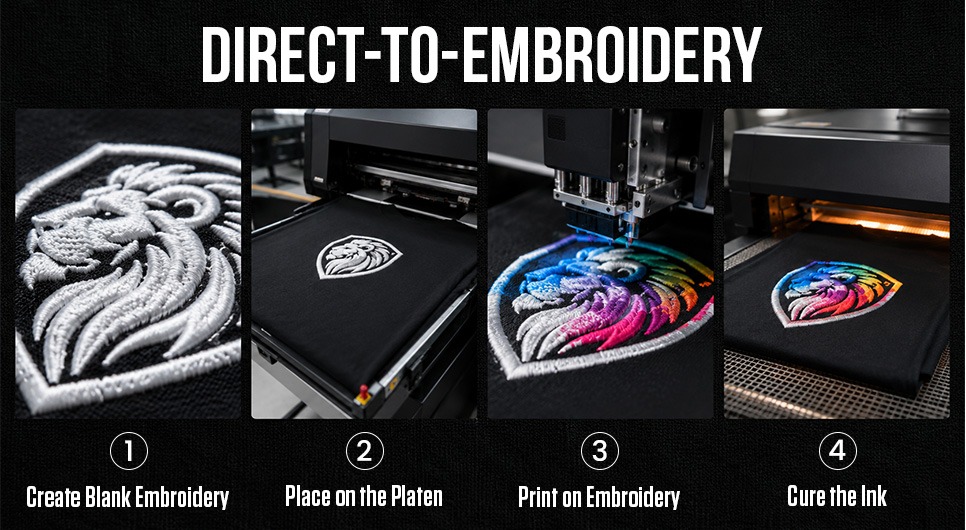
The entire system relies on commercial Brother DTG printers equipped with the AccuLine X camera system. As a matter of fact, it's the AccuLine X that enables this DTE capability on the printers.
In the past, you might have digitized a complex logo for many different thread colors. Now, you digitize it for just one. You stitch the entire design onto the blank garment using a solid white thread. You then load that freshly stitched item into the digital printer — a Brother GTXpro or a GTX600. A high-precision camera on these printers automatically scans the platen. It recognizes the exact position and angle of the white silhouette. The printer then sprays 1200 DPI water-based pigment ink directly over the raised threads.
This process creates a vivid, full-color image with a distinct 3D texture. The ink bonds permanently to the thread fibers delivering photorealistic details. It generates smooth color gradients that are physically impossible with a standard needle and thread.
Advantages of Direct-to-Embroidery
Upgrading to a hybrid printing system opens up big business potential. The daily advantages go beyond simply making a cool product.
- Unlimited Color Gradients: Traditional stitching cannot execute smooth color fades. The hybrid system prints precise color gradients directly onto the thread base.
- Thread Inventory Reduction: You only need white thread. You never have to special-order specific Pantone-matched cones for a single client run again.
- Unprecedented Detail: You can print microscopic text, patterns, and intricate photographic details directly on top of the textured base.
- Simplified Digitizing: Digitizers only create a single flat layer. They do not program complex color stops or underlay sequences for fifteen different needles.
- Flawless Registration: The high-resolution camera system is designed so the ink hits the thread perfectly. Very low likelihood of misprints and ruined garments — none that we know of.
- Highly Engaging Social Content: The visual process is amazing. You can capture oddly satisfying, faceless videos of the printer spraying ink over the white thread — like how Brother did it when promoting the tech. Or you can just grab a couple of videos of super-creative, highly-detailed designs blending threads and vibrant prints. These product-focused clips perform well on social media platforms.
Traditional Embroidery vs. Direct-to-Embroidery
| Feature | Traditional Embroidery | Direct-To-Embroidery (DTE) |
|---|---|---|
| Color Limit | Restricted by needle count | No color restrictions |
| Gradients | Impossible to make smooth | Flawless and photorealistic |
| Digitizing Complexity | High (demands multiple layers) | Low (demands one white silhouette) |
| Thread Required | Hundreds of colored spools | Just white thread |
| Photographic Detail | No | Yes |
| Equipment Needed | Embroidery machine | Embroidery Machine & Brother DTG printer with AccuLine X |
Is DTE a Profitable Decoration Method?
It could be, because the technology is innovative enough to revolutionize how we decorate apparel. Not every artwork looks great embroidered. But if you can get your machine to just embroider it in white and have the DTG printer make it photorealistic, any artwork will look fantastic.
But adding a hybrid setup like this is a serious financial commitment. We recommend carefully evaluating the long-term return on investment. The profit margins on hybrid apparel should be substantial. Businesses that gladly pay premium prices for embroidered apparel will likely not hesitate to pay more for an "enhanced embroidery print" of their logos.
The real cost savings come from shop efficiency. You completely eliminate the downtime associated with re-threading needles for different jobs while also cutting down your thread inventory costs.
At this point, it won't be wrong to conclude that the ability to print digital designs on embroidered fabric allows for massive retail markups.
Disadvantages and Limitations of DTE
Now we examine the downsides, because pretty much everything good has a catch.
- High Capital Expense: You need an industrial embroidery machine. You also need a commercial Brother DTG printer. That's a big cash investment.
- Slower Overall Workflow: A single shirt goes through three distinct stations. It hits the embroidery machine, likely a pretreatment station, and finally the digital printer. This obviously takes longer than a standard single-step print job.
- Pretreatment Reliance: You must apply pretreatment correctly. Poor pretreatment techniques might end up damaging your DTE service's credibility.
- Space Requirements: Commercial digital printers and their required conveyor dryers take up a lot of floor space.
Best T-Shirts for Direct-to-Embroidery
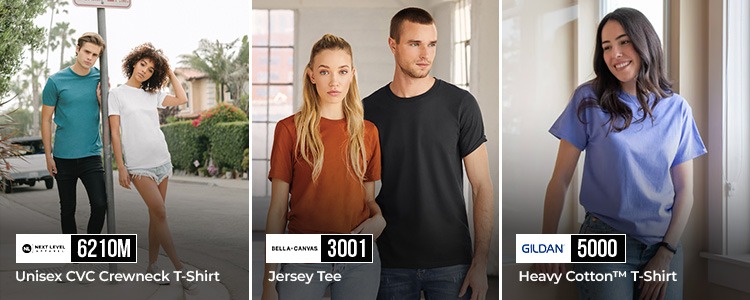
The garment choice matters just as much as the machine settings. YouApparel offers an excellent selection of wholesale blanks that take hybrid printing beautifully.
Cotton t-shirts like the Gildan 5000 can handle the hoop tension easily. The Bella+Canvas 3001 is a softer alternative. It is known to take digital ink incredibly well. The Next Level 6210M CVC blend also resists shrinkage and provides a very stable base for the initial white stitching.
Best Polo Shirts for Direct-to-Embroidery
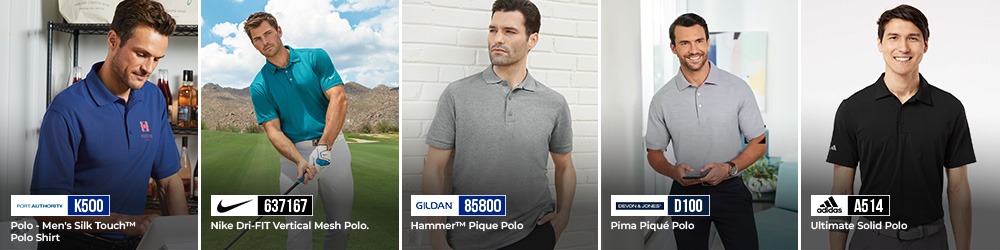
Polos are the absolute bread and butter of corporate decoration. Styles like the Port Authority K500 are a great pick if you need polyester fabric designed to take prints. The 65/35 poly/cotton blend holds the white thread base perfectly. The hybrid ink can then deliver a stunning logo finish without the heavy feel of thick traditional stitching. The Nike Dri-FIT Polo 637167 is a premium moisture-wicking alternative though it requires a solid polyester thread base to handle the activewear environment. But the final hybrid print will certainly look sharp. In YouApparel, you can go for styles like the Gildan 85800 Hammer™ pique, the D100 from Devon & Jones featuring premium Peruvian Pima cotton, the A514 Ultimate365 polo from Adidas, and more options made of polyester and cotton-poly blends.
Best Hoodies for Direct-to-Embroidery
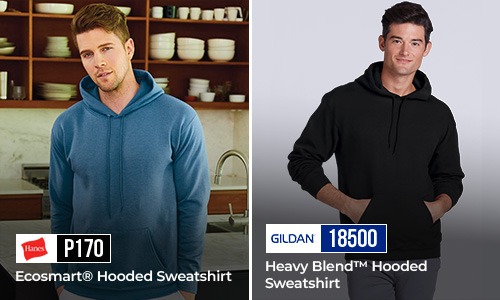
Fleece requires a bit more technical attention. The Hanes P170 is a great pick as it's known for its stable PrintPro® XP fleece surface. To keep the white base stitches from sinking into the fleece before the printing stage, you may want to use water-soluble topping during the initial embroidery phase. The Gildan 18500 is another fantastic option that's budget-friendly. Its 50/50 blend holds flat stitches well, creating a solid canvas for the inkjet pass.
Best V-Neck Sweaters for Direct-to-Embroidery
Sweaters are tricky because the knit ones can easily distort.
The Harriton M425 V-neck sweater features an acrylic jersey knit. Though the surface is smooth, there is a chance that it could prevent the white base thread from sinking. Meanwhile, the Port Authority SW300 is another acrylic knit that actually holds up well. It's best to avoid chunky cable-knit sweaters. The digital printer cannot spray ink evenly over a wildly uneven, heavily textured surface.
Traditional Embroidery vs. DTG Printing vs. DTE
| Attribute | Patch/Traditional Embroidery | DTG Printing | Hybrid DTE |
|---|---|---|---|
| Decoration method | Colored thread | Inkjet ink directly on fabric | Inkjet ink directly on white thread |
| Photo-quality detail | No | Yes | Yes (on a raised surface) |
| Texture / feel | Raised and dense | Flat with slight hand | Raised threads with integrated ink |
| Setup time | High (threading colors) | Low | Medium |
Step-by-Step Direct-To-Embroidery Process
Running a DTE job requires a specific workflow. It relies on a seamless handoff between your hardware.
- Stitch the Base: You take the customer artwork. You digitize a solid, single-color silhouette block. You load the garment into any standard commercial embroidery machine. You stitch the solid design using only white polyester thread.
- Pre-Treat the Garment: You must apply a liquid pretreatment to the embroidered area so it allows the digital ink to bind correctly to the synthetic thread and the surrounding fabric.
- Camera Alignment: You place the garment onto the printer platen. The alignment software takes control. The high-resolution camera scans the stitched area. It perfectly aligns the digital print file with the stitched base. You never have to hoop the garment perfectly straight.
- Print and Cure: You push the start button. The machine prints the vivid design directly over the white stitching. You remove the finished item. You run it through a standard conveyor dryer or a heat press to cure the ink permanently.
Best Embroidery Machines for DTE
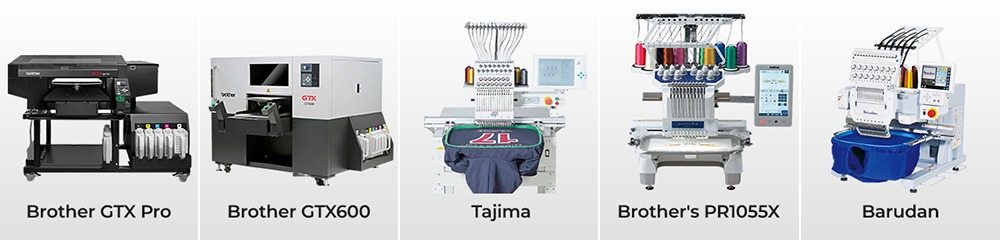
You need the right hardware combination to execute this process profitably.
- Brother GTX Pro: This is one of the best entry-level commercial options for the printing phase. It features a fast ink cure time and is perfect for shops transitioning into DTE decoration for the first time.
- Brother GTX600: This absolute beast is built for mass production, boasting a massive 24" x 24" print area and delivers true industrial-grade speed.
- Embroidery Hardware: You can use any high-quality commercial embroidery machine. Tajima, Barudan, or even Brother's PR1055X multi-needle machines all lay down a perfect white base for the printer.