


Core Performance T-Shirts: Fabric Analysis & Brand Comparison
By: YouApparel Posted on: Sep 3, 2026Core performance t-shirts are not basic performance t-shirts, contrary to what many people think. It’s essentially a “product tier” that usually means an entry-level polyester or polyester-rich foundational t-shirt meant for athletic use. This blog gives you a comprehensive understanding of Core Performance T-Shirts, what makes them distinctive compared to standard performance tees, their fabric specialties, and what they are not. This blog also covers some of the most popular core performance styles in YouApparel, featuring offerings from leading brands like Badger Sport, Russell Athletic, Gildan, Core 365, and more.
Core performance t-shirts might sound like t-shirts built for performance with a specific performance fabric, but they are actually a product tier. In the wholesale apparel market, “core performance” usually means an entry-level polyester or polyester-rich foundational t-shirt for athletic use. These tees will offer moisture management, quick drying, team use, and decoration.
The label sounds simple. The specs are not.
Badger B-Core line, Russell Athletic Dri-Power Core, Gildan Performance, Holloway Momentum, Holloway Coolcore, and Core 365 all use performance language, but they do different jobs.
Some focus on antimicrobial finish.
Some focus on UPF sun protection.
Some focus on print stability, colorfastness, or cooling.
This guide compares the details that are highly preferred, including moisture management, odor control, UV protection, antimicrobial finish, fabric hand, decoration fit, and bulk buying use.
In a nutshell:
Core performance fabric is not one material. It is usually 100% polyester or a polyester-rich blend made to move sweat away from the skin and dry faster than cotton. The best shirt depends on the job. It offers protection outdoors from the sun, works for team sports, makes practical work uniforms, takes sublimation well, and comes in hi-vis colors. All of that at significantly low cost when bought in bulk.
What is Core Performance Fabric?
Core performance fabric is the primary feature of foundational, lightweight t-shirts meant for athletic and uniform use. It is not compression wear, neither is it a merino. The fabric is what makes the basic performance tee that most buyers use for teams, schools, events, gym staff, outdoor crews, branded uniforms, and wholesale apparel programs.
The Naming Convention Nobody Explains
“Core” usually means baseline performance tier. That is why the same word appears across several brands:
- Gildan Performance Core
- Russell Dri-Power Core
- Badger B-Core
The Core 365 Capital and Core 365 Fusion ChromaSoft also fall under this category. These are not the same shirt, however. They use different knits, different weights, different fit profiles, and offer different performance benefits. Check the spec sheet in YouApparel’s product pages for sizing info while the page itself presents what the t-shirt offers. Don’t just go with the word “Core” while browsing.
What it is Actually Made Of
Core performance t-shirts are either 100% polyester or polyester-rich blends. Polyester is a hydrophobic, synthetic material. It does not absorb water the way cotton does. Instead, fabric structure moves moisture across the fibers and out to the surface, where it can evaporate.
Common weights in this group range from about 3.5 oz./yd² to about 5.0 oz./yd².
Lighter shirts usually feel more athletic and dry faster. Heavier shirts may feel more substantial, offer better opacity, and work better for some decoration methods.
Jersey vs Interlock vs Spun
The fabric build changes how the shirt feels, prints, and performs.
Jersey knit: Feels lighter, softer, and more flexible. It often has more drape. Alleson Athletic 7930 placket jersey and Core 365 CE111 are examples of performance jersey styles.
Interlock knit: Smoother, denser, and more stable, interlock knits feel more technical like they are meant to. Team 365 TT11, Holloway Momentum, and Core 365 Capital use interlock-style constructions.
Spun or cotton-feel polyester: Designed to feel less slick and more like a cotton tee. Gildan 42000 is often described as a cotton-feel polyester jersey, which makes it a practical choice for teams that want performance without a shiny athletic feel.
What “Core” is Not
Core performance is not automatically UPF-rated. It isn’t always waterproof, antimicrobial or odor-resistant either. Neither is it generally considered a good choice for cold weather.
Think of it as the standard performance tee level that dries fast and is easy to buy in bulk. They are certainly decoration-friendly, and practical for uniforms or sport.
How Does it Actually Help Performance?
Performance t-shirts help by managing sweat. Cotton absorbs sweat and holds it, which can make a shirt heavy, damp, clingy, and slow to dry. Polyester does not absorb much moisture into the fiber. A good performance knit moves sweat across the fabric and spreads it out. Evaporation does the cooling. The shirt simply helps move moisture to the place where evaporation can happen.
Moisture Management
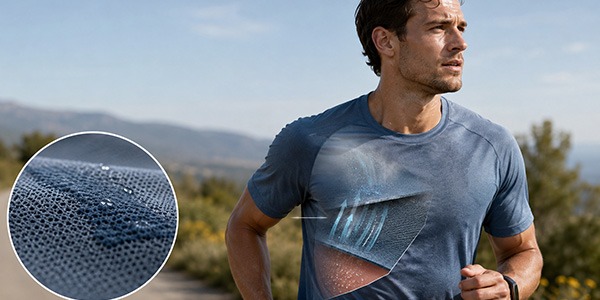
Moisture management means the shirt moves sweat away from the skin and spreads it across the fabric surface. This is also called wicking. The process depends on capillary action between fibers and yarns.
Brand names change, but the basic physics is similar:
- Russell Dri-Power
- Holloway Dry-Excel
- Badger B-Dry
- Core 365 moisture-wicking performance
Do moisture-wicking shirts actually work for running? Yes, in the right setting. They dry faster, feel lighter, and reduce the wet-shirt feeling compared with standard cotton. Their ideal use case is in dry heat conditions with moderate activity. They offer good value for gyms, sport, and outdoor work.
The limit is humidity. If the air is already loaded with moisture, evaporation slows down. No shirt can fully beat that.
Main advantages:
- Dries faster than cotton
- Stays lighter during activity
- Reduces wet fabric cling
- Helps limit chafing
- Works well for teams, gyms, events, and outdoor staff
Main tradeoffs:
- Can feel clammy in high humidity
- Sweat may run instead of soaking in
- Less insulating in wet-cold settings
- Polyester can hold body oils and odor
Anti-Odor Technology
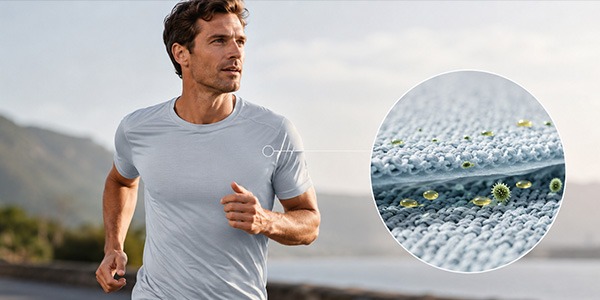
Polyester has a real odor problem. It tends to hold body oils more than cotton. Odor-causing bacteria feed on those oils, which is why many performance shirts can develop “permastink” after repeated wear.
Anti-odor technology is meant to reduce smell during use. It may use an odor-control finish, antimicrobial action, yarn design, or a brand-specific treatment. It can help a team shirt stay fresher through a shift, game, workout, or event.
But to be honest, many odor-control finishes are topical, often fading with repeated washing. Most brands do not publish a clear wash-cycle durability number for these finishes.
Use anti-odor performance tees for:
- Gym staff
- Sports teams
- Event crews
- Shared team kits
- Long shifts
- Warm-weather uniforms
Do not treat anti-odor as a washing replacement. It may help manage smell but does not actually clean the shirt.
UV Protection
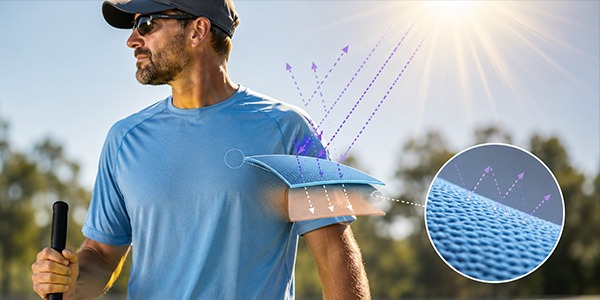
UPF means ultraviolet protection factor which measures how much UV radiation passes through fabric. UPF 30 blocks about 96.7% of UV. UPF 50 blocks about 98%. But not every performance tee has a UPF claim though.
Here are a few that fall under the “Core Performance T-Shirt” category that also offer UV protection.
- Core 365 Capital CE10: UPF 50+
- Holloway Momentum 222818: UPF 45+
- Team 365 TT11 Zone Performance: UPF 40+
- AllPro Men's Pro-Lock Performance T-Shirt 48000: UPF 50+
- Paragon Bahama Performance LS Hooded Tee 220P: UPF 50+
- Hanes Cool DRI® Performance T-Shirt 4820H: UPF 40+
UPF is affected by fiber type, knit density, color, stretch, wear, and wetness. Polyester usually performs better than thin cotton. Darker colors often protect better than light colors, and tight interlock fabrics can outperform loose jersey fabrics.UPF-rated performance tees are valuable for outdoor teams, coaches, groundskeepers, road crews, camp staff, field employees, and event workers.
Antimicrobial Finish
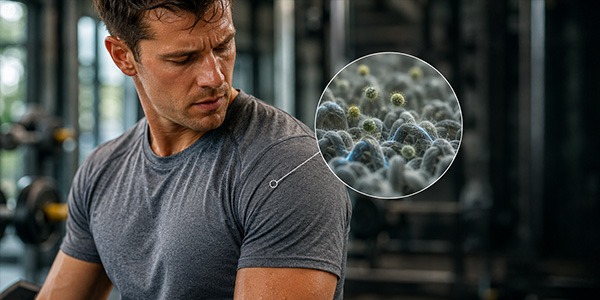
Antimicrobial and anti-odor are related, but they are not the same claim. Antimicrobial means the finish inhibits microbial growth on the fabric. Anti-odor means the shirt is built or treated to reduce smell.
These tees in YouApparel’s wholesale t-shirts collection feature antimicrobial properties:
- Badger B-Core 4120
- C2 Sport 5100 Unisex Performance Tee
- Harriton Charge Snag and Soil Protect T-Shirt M118
- Core 365 Fusion ChromaSoft CE111
- Alleson Men's B-Core Placket Jersey 7930
Antimicrobial finishes can be useful for team kits, gym uniforms, work shirts, and apparel that gets heavy repeat use. Still, they do not sanitize the wearer, and the finishes may lose strength over time.
Brand-by-Brand Analysis
Here is a quick comparison of some of our in-demand styles from various brands.
| Style | Fabric / Knit | Weight | Moisture | Odor / Antimicrobial | UPF | Best For |
|---|---|---|---|---|---|---|
| Badger B-Core 4120 | 100% polyester performance fabric | 3.5 oz. | Yes | Antimicrobial | - | Teams, gyms, motion |
| Holloway Momentum 222818 | 100% polyester interlock Dry-Excel | 4.1 oz. | Yes | Odor-resistant | UPF 45+ | Outdoor sport, print control |
| Holloway Electrify 222571 | 87/13 polyester/elastane Coolcore | 4.25 oz. | Yes | Cooling technology focus | UPF 50+ body | Hot climates, premium sport |
| Russell 629X2M | 100% polyester interlock | 4.1 oz. | Yes | Anti-odor | UPF 30+ | Everyday teams, relaxed wear |
| Gildan 42000 | 100% polyester jersey, cotton feel | 5.0 oz. | Yes | Freshcare antimicrobial | - | Bulk, sublimation, decoration |
| Core 365 CE111 | 100% polyester jersey ChromaSoft | 4.5 oz. / 160 gsm | Yes | Antimicrobial | - | Uniform colorfastness |
| Core 365 CE10 | 100% polyester interlock | 4.13 oz. / 140 gsm | Yes | - | UPF 50+ | Outdoor crews, sun exposure |
Choosing Between Core 365 ChromaSoft and Core 365 Capital
Core 365 CE111 and CE10 - two very popular styles from the brand- are easy to confuse because both are performance t-shirts. They do different jobs.
| Feature | Fusion ChromaSoft CE111 | Capital CE10 |
|---|---|---|
| ⚖️ Weight | 4.5 oz. / 160 gsm | 4.13 oz./yd² / 140 gsm |
| 🧵 Knit | 100% polyester jersey | 100% polyester interlock |
| 💧 Moisture-wicking | ✅ Yes | ✅ Yes |
| 🛡️ Antimicrobial | ✅ Yes | ❌ No |
| ☀️ UV Protection | ❌ No | UPF 50+ |
| 🎨 Color Technology | ChromaSoft cationic dye colorfastness | Standard |
| ✨ Hand Feel | Soft, cotton-feel performance | Smooth, technical |
| 👕 Fit | Active / slimmer feel | Unisex |
| 🏆 Best For | Uniforms, printed merch, color consistency | Outdoor work, sun exposure, hot climates |
So basically ChromaSoft and Capital are near-opposites under one brand name.
- Choose Core 365 Fusion ChromaSoft CE111 if your priority is colorfastness, soft hand, and antimicrobial performance for branded uniforms or printed merch.
- Choose Core 365 Capital CE10 if your priority is UPF 50+ sun protection, lighter fabric, and outdoor crew use.
Neither gives you both antimicrobial and UPF 50+ in the same shirt.
Fabric Advantages and Disadvantages
| Advantage | The Catch |
|---|---|
| 💧 Dries fast and stays light | Feels clammy in high humidity because evaporation slows |
| 📏 Holds shape and resists shrinking | High dryer heat and ironing can damage polyester |
| 🎨 Strong color range | Polyester may need low-bleed inks for screen printing |
| 📦 Good for bulk orders | Lightweight white polyester might be see-through |
| 🛡️ Anti-odor or antimicrobial options | Many finishes may fade with repeated washing |
| ☀️ UPF protection on some styles | Rating can drop with stretch, wear, or wetness |
| 🪡 Snag-resistant options | Polyester can hold body oils and odor |
| 🖨️ Sublimation-friendly options | Sublimation works best on light-colored polyester |
| ♻️ Recycled or certified options exist | Synthetic fibers can shed microplastics during washing |
The point is cotton still wins in some cases. Core performance tees are viable only if you need to want budget-friendly and lightweight t-shirts designed for athletic use.
In YouApparel, you can find premium performance t-shirts wholesale blank or customized from big names like Under Armour and Adidas. But if the use is simply low-exertion indoor wear, blank cotton t-shirts wholesale are the right call. Especially if comfort is more prioritized than performance. Cotton can also be better for people who dislike the feel of synthetic shirts.
Polyester wins when the job involves sweat, sport, heat, repeated team use, quick drying, sublimation, or outdoor activity. Core performance tees are if you want all of these in a lightweight garment that won’t cost your team a pretty penny.
Which Core Performance Tee Should You Buy?
Here’s the gist of it.
- For outdoor work, start with UPF.
- For decoration, start with fabric stability and dye migration risk.
- For sport, start with weight, fit, and stretch.
- For uniforms, start with color consistency and reorder availability.
How to Not Ruin a Performance Tee
- Wash performance T-shirts inside out in cold water
- Use mild detergent
- Skip fabric softener because it can coat fibers and reduce wicking
- Avoid dryer sheets for the same reason
- Dry on low heat or hang dry
- Do not iron polyester performance tees
- Wash sweaty shirts soon after use
NOTE: Always follow the garment label first.
Frequently Asked Questions
Q. What is a core performance t-shirt?
A core performance t-shirt is an entry-level athletic or uniform tee made from polyester or a polyester-rich blend. It is built for moisture management, quick drying, team use, and decoration.
Q. What does moisture wicking mean?
Moisture wicking means fabric moves sweat away from the skin and spreads it across the outer surface so it can evaporate faster.
Q. What is moisture-wicking fabric made of?
Most moisture-wicking performance tees are made from polyester, polyester blends, nylon, or engineered synthetic fibers. YouApparel’s t-shirts wholesale selection features 100% polyester and polyester-blend performance t-shirts from top brands in the market.
Q. Is polyester moisture wicking?
Polyester can be moisture-wicking when the yarn and knit structure are built to move sweat. The fiber itself does not absorb much water, which helps it dry quickly.
Q. Is cotton moisture wicking?
Standard cotton doesn’t wick moisture but absorbs and holds it. It can feel comfortable at rest, but it dries slowly during activity. That is why cotton is usually not the first choice for running, sport, or hot outdoor work.
Q. Is moisture wicking the same as waterproof?
No. Moisture-wicking fabric moves sweat through the shirt. Waterproof fabric blocks water from passing through.
Q. Do moisture-wicking shirts actually work for running?
Yes, especially in dry heat and moderate to high activity. They dry faster than cotton and feel lighter. In high humidity, performance drops because evaporation slows.
Q. What is the difference between anti-odor and antimicrobial?
Anti-odor means the shirt is made or treated to reduce smell. Antimicrobial means the fabric inhibits microbial growth on the fabric. They can overlap, but they are not the same claim.
Q. Does antimicrobial treatment wash out?
Some antimicrobial finishes are topical and may fade after repeated washing. Most brands in this group do not publish clear wash-cycle durability numbers.
Q. What is UPF and how is it different from SPF?
UPF measures UV protection in fabric. SPF measures sunscreen protection on skin. UPF 30 blocks about 96.7% of UV. UPF 50 blocks about 98%.
Q. Can you sublimate on a core performance t-shirt?
Yes, if the shirt is polyester and light-colored. Sublimation works best on white or light 100% polyester because the dye bonds with polyester fibers.
Q. Can you tie-dye a moisture-wicking shirt?
Standard cotton tie-dye methods do not work well on polyester performance shirts. Polyester needs disperse dye and higher heat. For most buyers, sublimation or DTF printing is the better decoration route.